 QUARANTA DOLORI™

“I’ll ignore it and it’ll go away”: a brave idea, often not very useful
When pain hangs around, the temptation arrives.
Ignore it. Grit your teeth. Pretend nothing’s wrong.
Sometimes it looks heroic.
Often it’s just exhausting.
Listening to pain doesn’t mean fixating on every twinge.
It means taking it seriously as an experience. And looking for what influences it.
What persistent pain means
In the guideline NICE NG193, chronic (or persistent) pain is pain that persists or recurs for more than 3 months.
It can be:
- primary: without a condition that explains it well, or with an impact greater than what can be seen;
- secondary: linked to a condition that explains it;
- or a mix of the two.
The ICD-11 classification (the WHO’s international list of diseases, also summarised by IASP) recognises chronic pain as a health condition.
The European Pain Federation (EFIC) points to the biopsychosocial model.
In plain words: these all count together
- the biology (tissues, nerves, physical health, sleep, activity…);
- the psychology (mood, fear, expectations, coping strategies…);
- the social side (work, relationships, support, life stress…).
It’s not “just physical”.
It’s not “all in your head”.
It’s real. Precisely because it’s an integrated experience.
Understanding: three doors, not just one
According to the IASP notes on the definition of pain (2020), biological, psychological and social factors influence the experience to varying degrees.
In its assessment section, NICE NG193 encourages talking about:
- daily activities and sleep;
- physical and psychological wellbeing;
- stressful events;
- relationships and work;
- practical worries;
- and also what already helps you.
Ignoring all this can encourage avoidance and less movement.
Understanding opens the way to more complete care.
Gradual movement: what the evidence says
For chronic primary pain, NICE NG193 recommends offering a supervised group exercise programme (for people aged 16 and over).
It should be adapted to needs, preferences and abilities.
It also encourages physical activity for long-term health.
A Cochrane review (Hayden and colleagues, 2021) on exercise for chronic non-specific low back pain finds moderate-certainty evidence: compared with no treatment, usual care or placebo, exercise probably reduces pain. The effect on disability is smaller.
Reported side effects are mostly minor (for example soreness), at similar rates to comparison groups when measured.
Honest translation: it can help.
It’s not a magic wand.
And it’s not the same for everyone.
Gradual ≠ photocopied protocol
“Gradual” does not mean “add X minutes every Y days” for everyone.
In general terms it means:
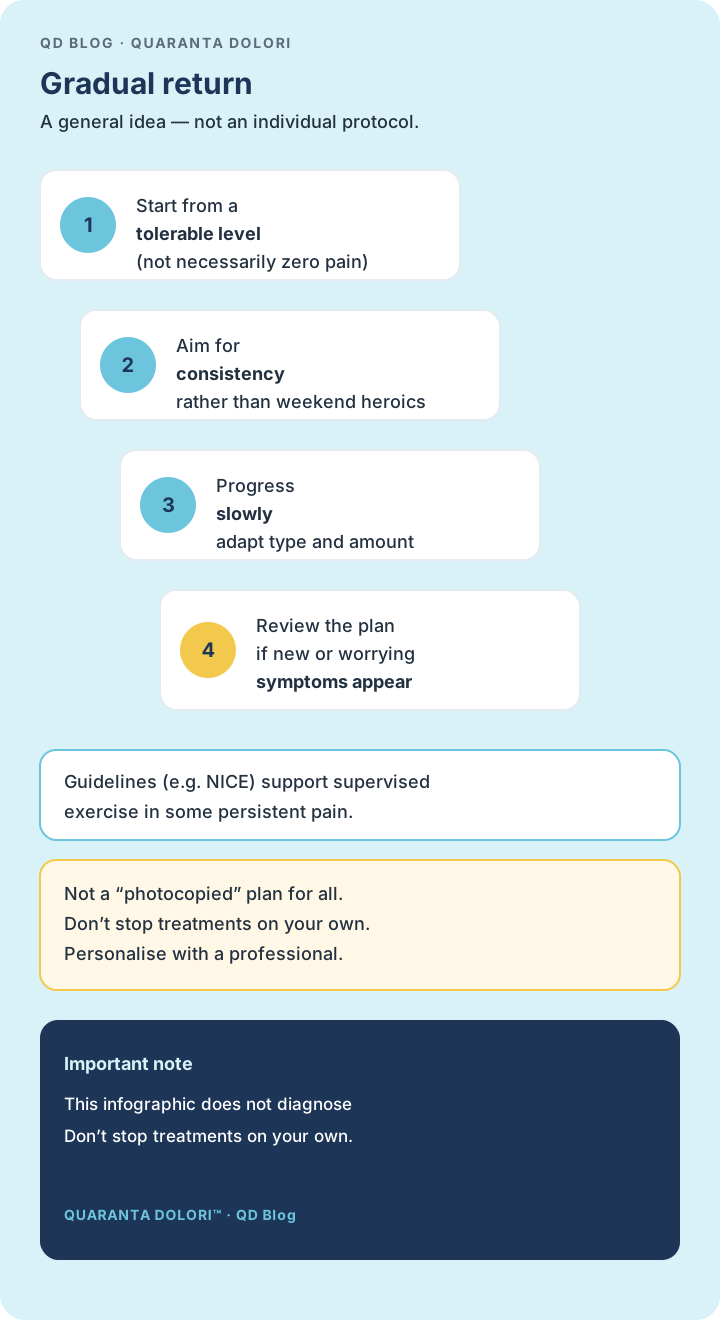
- starting from a tolerable level (not necessarily zero pain);
- aiming for consistency, not weekend heroics;
- progressing slowly;
- adapting the type and amount of activity to your abilities, preferences and clinical picture;
- reviewing the plan if new or worrying symptoms appear.
Don’t stop medicines or treatments already prescribed “because you’ve started moving”.
Any change should be agreed with the professional responsible for your care.
When to see someone
General guidance:
- pain that lasts for months and limits daily life, sleep or mood;
- flare-ups (flare-up) with a significant change in symptoms — NICE advises reassessment if the presentation changes;
- red flags (progressive neurological deficits, bladder or bowel problems, fever or feeling unwell, a history of cancer with new back pain, trauma, and similar): urgent assessment according to clinical criteria.
“Treated” doesn’t necessarily mean a single procedure.
It can include education, supervised exercise, evidence-based psychological support when appropriate, and care for underlying conditions.
In two lines
Persistent pain should be listened to and understood. Not denied.
Understanding it includes biology and real life.
Movement, when appropriate and graded, is one of the levers supported by guidelines and reviews — often useful, rarely miraculous, always to be personalised with a professional.