 QUARANTA DOLORI™
That “down to the bone” feeling
Many people describe a dull pain. Deep. “Inside”. “Down to the bone”.
It’s natural language.
Your body doesn’t hand you a label that says: muscle, tendon, bone, joint.
That would be handy. It doesn’t work that way.
Why deep pain “feels” like bone pain
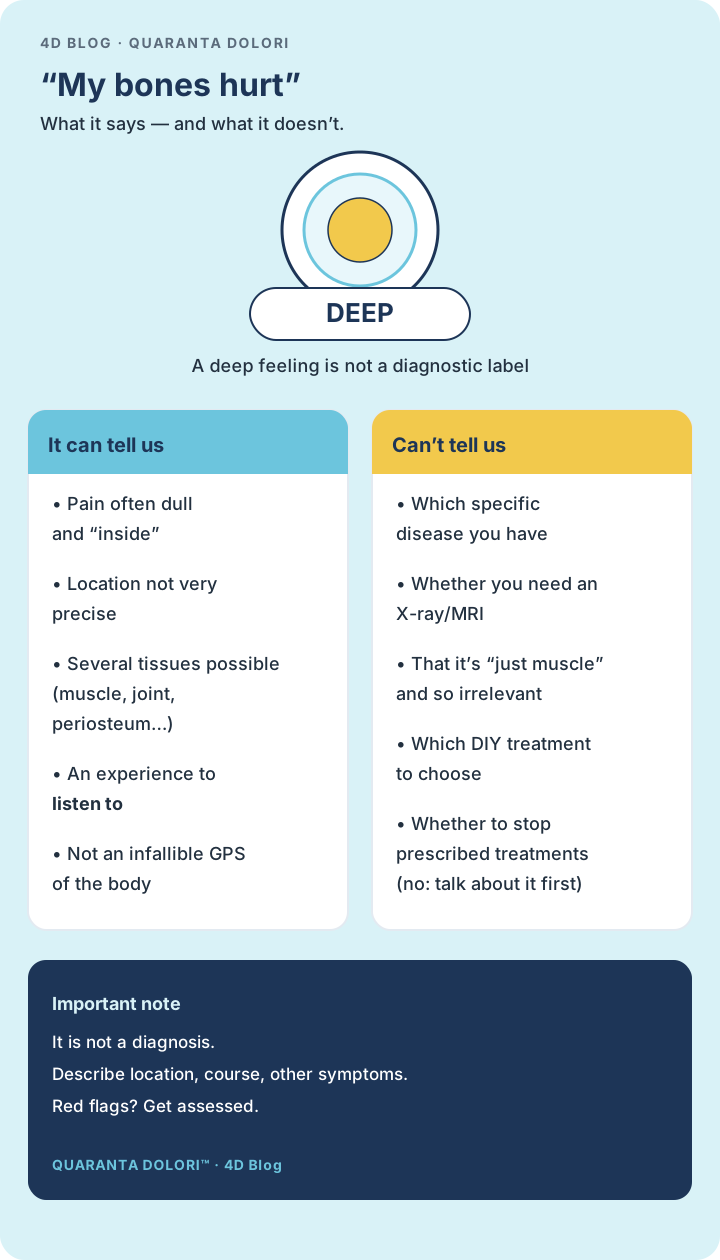
When assessing musculoskeletal pain (pain in muscles, bones and joints), the quality of the sensation does not precisely pinpoint the structure responsible.
A fact sheet from theIASP (International Association for the Study of Pain) puts it clearly:
- this pain is often dull and diffuse;
- it can be referred (felt away from the area that generates it);
- it is poorly localised in muscles;
- it is hard to tell apart, from the sensation alone, pain from tendons, ligaments, bones, joints or capsules.
So yes: you can feel something “in your bones” without that, on its own, being proof of a bone injury.
And the reverse: a bone problem doesn’t always come with a sensory label as clear as a road sign.
What can be said (calmly)
In plain terms, we can say that:
- pain is a personal experience (IASP 2020 definition and notes);
- it is not an infallible “GPS”;
- deep structures — muscle, periosteum (the bone’s “lining”), joints and other tissues — can produce deep and referred sensations;
- the words “in my bones” deserve to be listened to and respected.
According to IASP terminology, pain and nociception are not the same thing.
Nociception is the nerve signal.
Pain is what you experience.
You can’t work out the disease from the word you use to describe it.
And the activity of nerves alone doesn’t tell you the experience of pain.
What you can’t conclude on your own
From the phrase “my bones hurt” alone you can not conclude:
- osteoporosis, fracture, tumour, infection or “bone inflammation”;
- that it’s “just muscular” and therefore irrelevant;
- whether or not you need an X-ray or an MRI;
- that one exercise, or complete rest, will do the trick.
These decisions require a history (your story), an examination and, if needed, targeted tests.
Best to avoid two extreme sports: self-diagnosis by internet and downplaying at all costs.
When an assessment is useful (or urgent)
General guidance. Always to be put in the context of your own case.
In line with the spirit of the clinical resources NICE CKS on low back pain and sciatica regarding red flags.
Prompt or urgent assessment if, for example, you have:
- severe bone or back pain that is getting worse, at night, and does not improve with rest;
- a known history of cancer and new spinal or bone pain;
- fever, feeling generally unwell, unexplained weight loss;
- major trauma — or minor trauma if you have known osteoporosis or have been taking steroids for a long time;
- local swelling, deformity, inability to bear weight on the limb;
- progressive neurological deficits, bladder or bowel problems, “saddle” anaesthesia (loss of sensation in the perineal area).
Planned assessment even without urgency if the deep pain persists, disturbs your sleep, work or movement, or worries you.
A professional helps separate common causes from situations that need investigating.
Listening without scaring
Understanding that “in my bones” is often an ambiguous description does not mean ignoring the symptom.
It means:
- listening to it;
- describing it well (where, when, what makes it worse or better, other symptoms);
- deciding together with a professional whether and how to look into it.
The goal is not to reassure at all costs.
Nor to alarm for sport.
It’s to give direction.