 QUARANTA DOLORI™
Yesterday your neck, today your shoulder
It happens a lot.
Yesterday your neck. Today your shoulder. Or your buttock, and then your thigh.
The question comes right away: “Is something getting worse?”
Not always.
And no: your body hasn’t decided to take a tour of painful spots just to keep you awake. (Even if, sometimes, it really feels that way.)
What referred pain is
In pain science we talk about referred pain (or simply “referral”).
In plain words: you feel pain in one place, but the signal can originate from (or be influenced by) another structure.
It’s a mechanism described in the clinical literature, not something made up on social media.
A review in Frontiers in Neurology (Jin and colleagues, 2023) explains that referred pain:
- can come from tissues far from the area that “burns”;
- not the same thing as a nerve pinched along a root (radicular pain);
- has maps that often overlap.
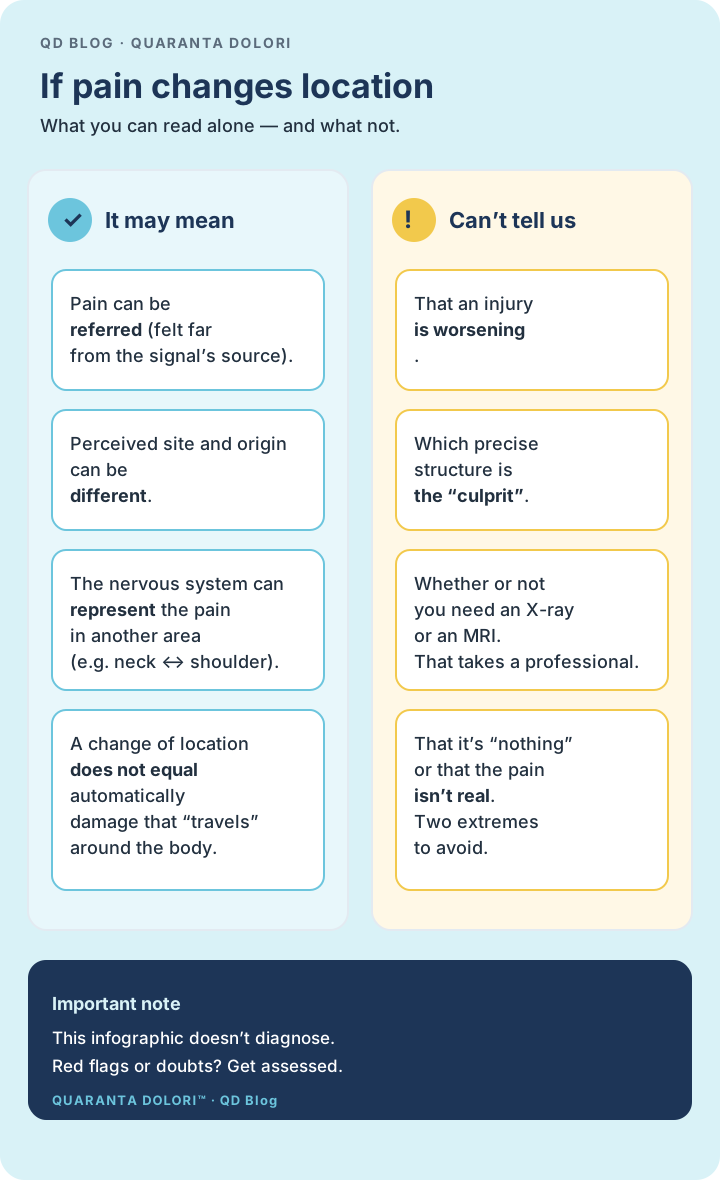
So: the location you feel isn’t enough to say “there’s the broken part”.
Pain and damage are not the same thing
TheIASP (the international association that studies pain) updated the definition in 2020.
Pain is an unpleasant experience. Sensory and emotional. Associated — or resembling that associated — with actual or potential tissue damage.
Two useful notes, again from IASP:
- Pain and nociception are not the same thing.
Nociception is the nerve signal from tissues that may be in danger.
Pain is what you experience.
- Pain is personal. Biology, thoughts, emotions and life context all play a part.
So: if the location changes, it does not mean automatically that damage is “travelling” around the body.
And watch out for the other extreme: it does not automatically mean “nothing important”.
Two shortcuts. Both awkward. Both best avoided.
Why it can seem to “move”
Pain from muscles and deep tissues is often dull, “cramp-like”.
Compared with skin pain, it is harder to locate. And it can be referred to other deep areas.
If signals from the tissues last a long time, some neurons in the nervous system can become more “reactive”.
In technical terms we talk about increased excitability and, sometimes, hyperalgesia (more pain from stimuli that used to hurt less) and referral (pain “sent” elsewhere).
Jin and colleagues (2023) summarise two main ideas about the mechanisms:
- Convergence: several signals arrive on the same “relay” neurons. The brain can represent the pain in a different location.
- Peripheral contributions linked to nerve fibres that branch in two (dichotomizing afferents).
In practice: the nervous system can show you pain in a different place from where the problem starts.
Neck and shoulder taking turns? Possible.
Lower back and buttock? That too.
On their own, though, these “jumps” don’t prove a linear structural worsening. As in: “yesterday it was here, so today it’s worse over there”.
What you can’t conclude on your own
From the mere fact that “yesterday it was here, today it’s there” you can not conclude on your own:
- that an injury is necessarily getting worse;
- that it’s “all in your head” (the pain is still real);
- which precise structure is involved;
- whether or not you need an MRI.
That takes a clinical history, an examination and professional judgement.
Scans and the location you perceive don’t always match. And different patterns can look alike.
Yes: it’s a bit less cinematic than “catching the culprit in a single frame”. But it’s more honest.
When it’s wise to get assessed
General guidance. It does not replace an examination.
Talk to a healthcare professional, or seek urgent assessment according to clinical criteria, if you have, for example:
- new pain after major trauma;
- pain that is getting worse, at night, and does not improve with rest, or with fever, feeling generally unwell, unexplained weight loss;
- neurological signs: progressive weakness, tingling/numbness typical of a nerve root, bladder or bowel problems, loss of sensation in the perineal area.
If the location changes but the pain stays manageable and there are no red flags, you can still ask for an opinion. Better to get clarity than to come up with a theory on your own.
In two lines
Pain that changes location can be due to referral mechanisms and to how the nervous system processes signals.
It is not, on its own, proof of a “migrating fault”.
Understanding this reduces needless fear.
It does not mean you can underestimate new, severe or unusual symptoms.